![[YAHUSHUA HA MASHIACH] THE CHIEF CORNERSTONE MINISTRY](https://yahushua-thechiefcornerstone.com/wp-content/uploads/2017/09/days-of-awe.png)
 Posted by
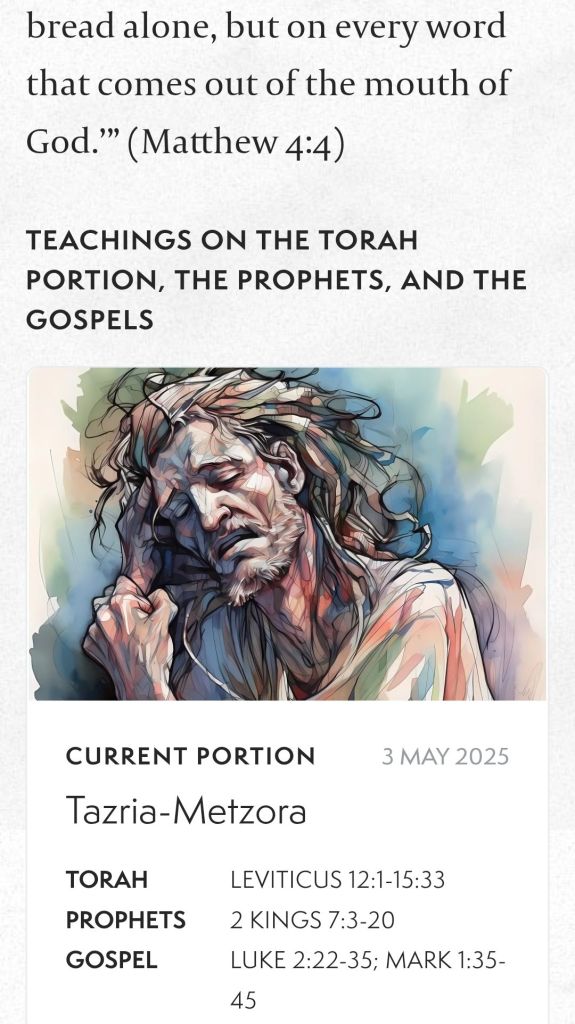
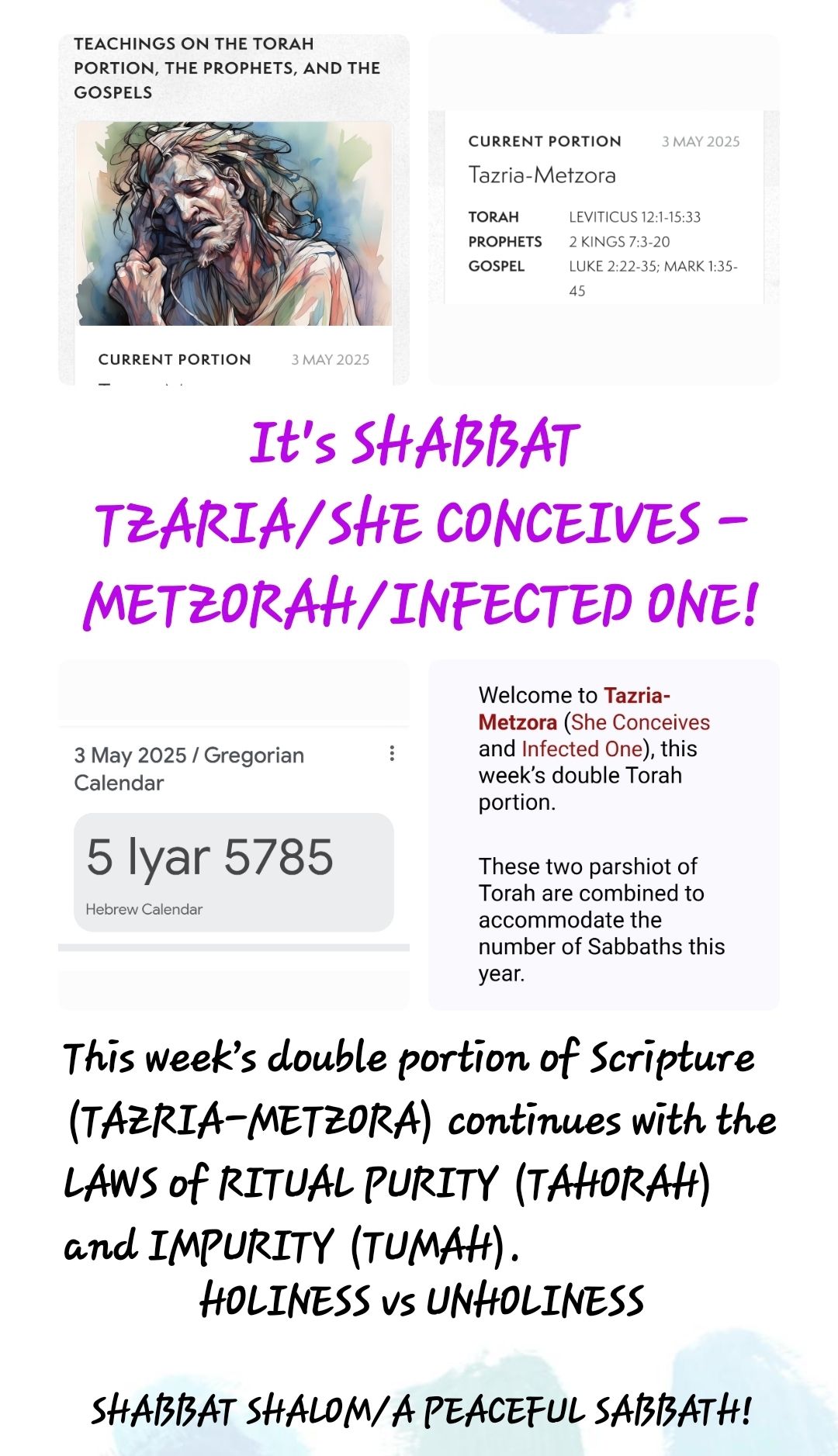
SHABBAT SHALOM/A PEACEFUL SABBATH!
Saturday 3rd May 2025/IYYAR 5
SHABBT TZARIA/SHE CONCEIVES-METZORA/INFECTED ONE
YAHUSHUA HA MASHIACH [JESUS CHRIST of Nazareth; Not Yeshua! ; Not YeshaYAHU!] Is THE LORD OF THE SABBATH, HalleluYAH HalleluYAH!
In SHEMINI, last week’s TORAH PORTION, YAH [GOD] gave INSTRUCTION for THE KOSHER LAWS, identifying which animals one could eat. It also discussed a few LAWS OF RITUAL PURITY, INSTRUCTING the ISRAELITES “to make a distinction between THE HOLY and THE PROFANE, and between THE UNCLEAN and THE CLEAN.” (Leviticus 10:10)
This week’s double portion of Scripture (TAZRIA-METZORA) continues with the LAWS of RITUAL PURITY (TAHORAH) and IMPURITY (TUMAH).
The Purification of Tzaraat
“And the leper who has the plague, his clothes shall be torn, and the hair of his head shall go loose, and he shall cover his upper lip, and shall cry: ‘Unclean, unclean [tameh, tameh]. All the days that he has the plague, he shall be unclean; he is unclean; he shall dwell alone; outside the camp.’” (Leviticus 13:45–46)
Both Tazria and Metzora focus on the laws of leprosy, a spiritual condition (created by sin) that causes the afflicted to become impure.
These portions outline laws regarding how to handle the metzora, the one who is infected, as well as how he or she may be purified once healed.
The Hebrew word that is translated leprosy, tzaraat, does not actually correspond to the modern day affliction of leprosy. Its origin is spiritual, but it obviously has a physical manifestation.
The condition is identified by a priest, not by a doctor.
In fact, tzaraat can afflict a person, house, or article of clothing.
How does the community of Israel deal with a person afflicted by tzaraat— a metzora?
Once it is confirmed through a series of tests that the condition is indeed tzaraat, the metzora is declared tameh (impure or unclean).
The afflicted one is then isolated from the community in order to prevent defiling and infecting others through contact. The metzora must dwell alone outside the camp until they are completely healed.
It is the role of the priest to periodically check on the afflicted person to determine when they can return to the community.
In terms of a house, if the tzaraat spreads after a week of quarantine, the infected stones are removed and thrown into an impure place.
If the lesions reappear after the stones are replaced, then the entire house is destroyed. The stones and wood are carried away to an impure place.
“Behold, if the plague spreads in the house, it is unclean. And he shall break down the house, the stone, and the timber, and all the mortar of the house; and he shall carry them out of the city into an unclean place.” (Leviticus 14:44–45)
How does the community of Israel deal with a person afflicted by tzaraat— a metzora?
Once it is confirmed through a series of tests that the condition is indeed tzaraat, the metzora is declared tameh (impure or unclean).
The afflicted one is then isolated from the community in order to prevent defiling and infecting others through contact. The metzora must dwell alone outside the camp until they are completely healed.
It is the role of the priest to periodically check on the afflicted person to determine when they can return to the community.
In terms of a house, if the tzaraat spreads after a week of quarantine, the infected stones are removed and thrown into an impure place.
If the lesions reappear after the stones are replaced, then the entire house is destroyed. The stones and wood are carried away to an impure place.
“Behold, if the plague spreads in the house, it is unclean. And he shall break down the house, the stone, and the timber, and all the mortar of the house; and he shall carry them out of the city into an unclean place.” (Leviticus 14:44–45)
Once a metzora is healed, he or she then goes through the purification process outlined in the Torah.
“The Lord spoke to Moses, saying, ‘This shall be the torah [instructions] for the leprous person [תּוֹרַת הַמְּצֹרָע] for the day of his cleansing.’” (Leviticus 14:1–2)
For the healing process to be complete, and the metzora reintegrated into the community, a complex series of offerings are made, beginning on the first day with two clean birds — one that is killed and one that is released.
Although the metzora can return to the community, they must live outside their tent for seven days. On the seventh day, the metzora shaves off all hair, including the eyebrows, and bathes in water.
As part of the ceremony, on the eighth day of the purification process, the Kohen (priest) places some oil and blood, of the guilt offering (male lamb) upon the tip of the right ear of the one being cleansed, and upon the thumb of his right hand, and upon the big toe of his right foot. (Leviticus 14:10–14)
This represents atonement and cleansing of everything we hear, everything we do, and every path we take.
Cushite. ‘Has YHVH spoken only through Moses?’ they asked. ‘Hasn’t he also spoken through us?’ And YHVH heard this.” (Numbers 12:1–2)
God’s anger was kindled against Miriam, and He afflicted her with tzaraat, saying to her:
“Why then were you not afraid to speak against My servant Moses?’ The anger of YHVH burned against [Miriam and Aaron], and He left them. When the cloud lifted from above the tent, Miriam’s skin was leprous — it became as white as snow. Aaron turned towards her and saw that she had a defiling skin disease.” (Numbers 12:8–10)
This should be enough to give each of us a healthy fear of gossiping about or slandering anyone — especially those anointed of the Lord to serve Him in a position of public leadership or ministry.
The Messiah: Humble and Exalted
According to Sanhedrin 98b of the Talmud (Jewish oral tradition), the Messiah is called “chivara-the leper.”
One Jewish interpretation of the Messiah, expects Him to be high, mighty, and exalted, not lowly, afflicted or one who is associated with sinners or lepers.
This idea is based on Isaiah 52:13: “MY SERVANT shall be wise, exalted and lofty, and shall be very high.”
How can we reconcile these two descriptions of the MESSIAH? In HIS first coming, YAHUSHUA HA MASHIACH [JESUS CHRIST of Nazareth; Not Yeshua! ; Not YeshaYAHU!] came as a lowly servant, entering Jerusalem on a donkey.
HE ate with sinners and associated with tax collectors — behavior for which HE was misunderstood and despised.
HE died as the humble lamb led to the slaughter to make atonement for our sins.
“But HE was pierced for our transgressions, HE was crushed for our iniquities; the punishment that brought us peace was on HIM, and by HIS wounds we are healed.” (Isaiah 53:5)
YAHUSHUA HA MASHIACH did not come for the proud and righteous, but for the lepers of society — those who are poor, humble, sick, and outcast.
According to Jewish thought, the MASHIACH (MESSIAH) REDEEMER suffers the agonies of tzaraat by taking upon HIMSELF and personally suffering the pain of HIS people in exile (galut).
It is traditionally believed that the day of PURIFICATION in this TORAH READING, refers to the day of REDEMPTION when the MESSIAH comes. As Believers, we understand that YAHUSHUA HA MASHIACH did fulfill this.
“HE himself bore our sins in HIS BODY on the stake, so that we might die to sins and live for RIGHTEOUSNESS — by HIS wounds you were healed.” (1 Peter 2:24)
As well, MESSIAH will come again to heal all tzaraat in our world. On that day, HE will be exalted to rule and reign forever upon the Throne of David. Jewish exile will be a thing of the past, and HIS people will dwell securely in their own land.
“Of the greatness of HIS government and peace there will be no end. HE will reign on David’s THRONE and over HIS KINGDOM, establishing and upholding it with JUSTICE and RIGHTEOUSNESS from that time on and forever.” (Isaiah 9:7)
In that time,
“JUSTICE will be the belt around His waist, faithfulness the sash around His hips. The wolf will live with the lamb; the leopard lie down with the kid; calf, young lion and fattened lamb together, with a little child to lead them.” (Isaiah 11:5–6)

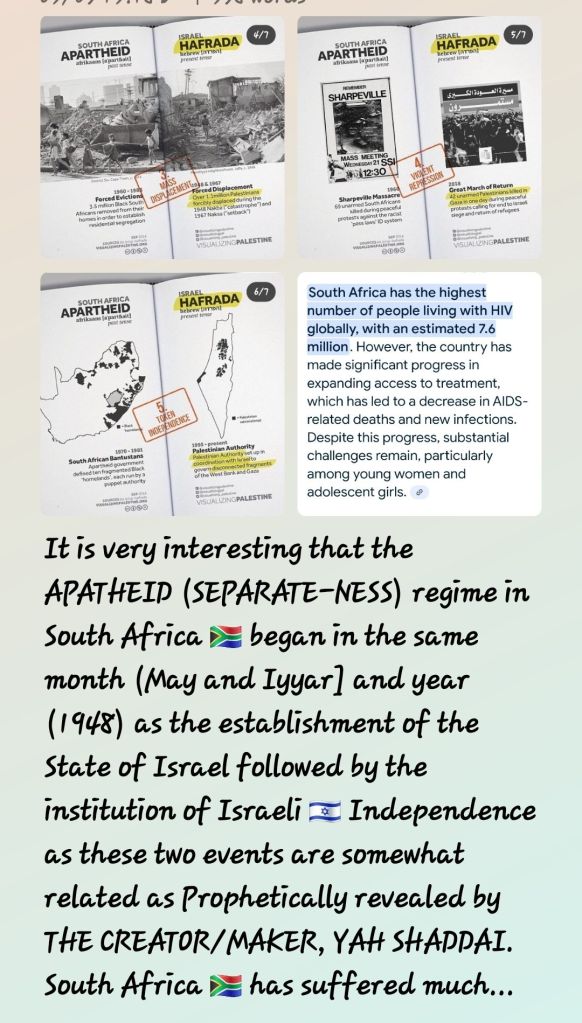
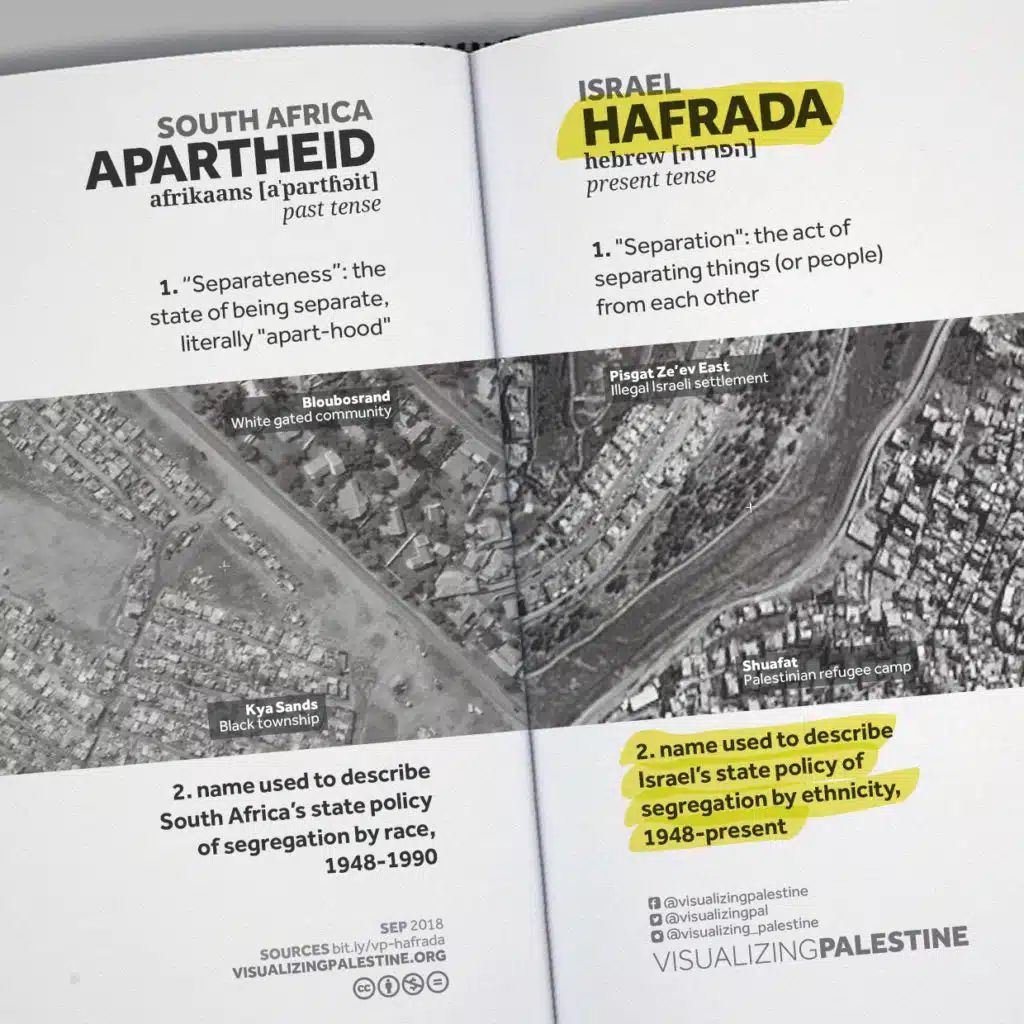
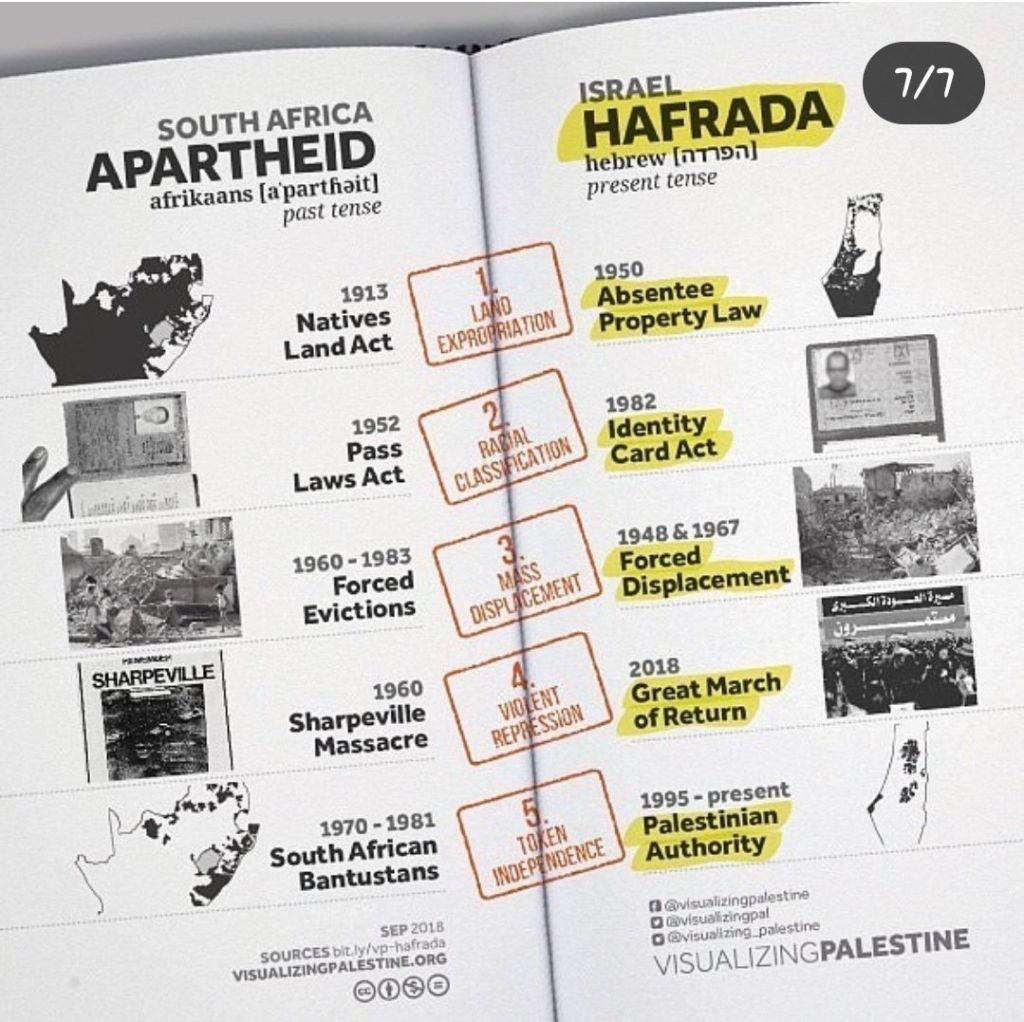

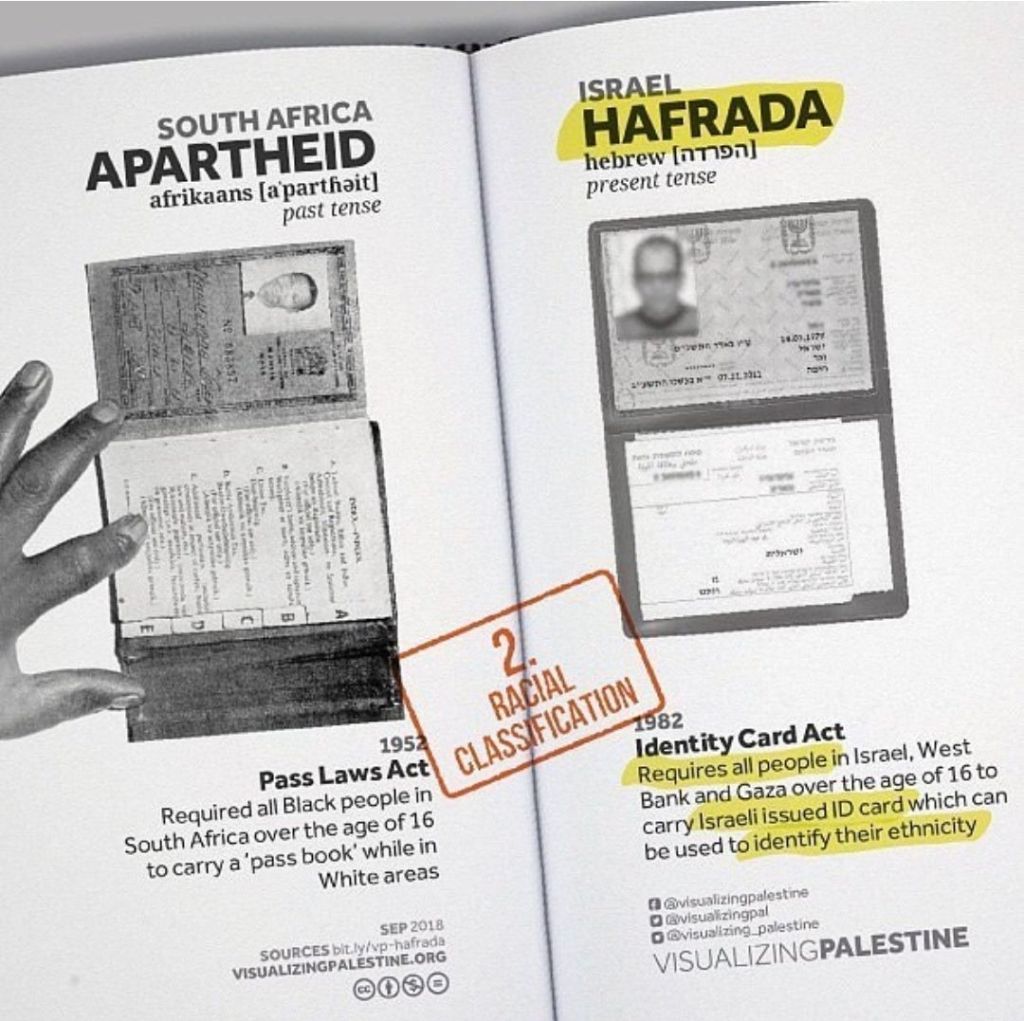





Apartheid in South Africa was formalized into law in 1948 when the National Party came to power. This date marks the official start of the system of racial segregation and discrimination against non-white South Africans. The apartheid regime lasted until 1994.
The system of apartheid began in May 1948, when the National Party (NP) came to power in a narrow election victory. The NP represented the interests of the white Afrikaans speaking population.
Video:
Video:
























SHALOM
 [YAHUSHUA HA MASHIACH] THE CHIEF CORNERSTONE MINISTRY